Jungles, Aces, and Thieves – Jerry Stubbs
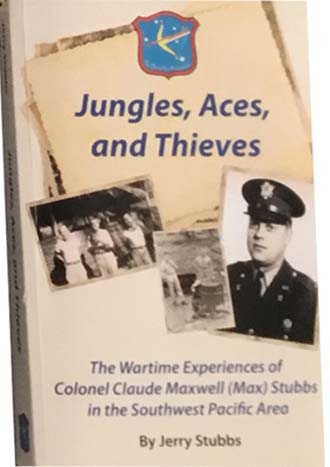
The Wartime Experiences of Colonel Claude Maxwell (Max) Stubbs in the Southwest Pacific Area.
In July 1940, Claude Maxwell, (Max) Stubbs reported for duty in the Army Air Corps, at Selfridge Field, Michigan. Assigned first to the 39th Fighter Squadron, he later joined the elite 475th Fighter Group – known as “Satan’s Angels” – upon its formation in spring 1943.
As an administrative officer in the Southwest Pacific theater of World War II, Max traveled from Sydney, Australia to Port Moresby, New Guinea in multiple battles and campaigns, and finally he saw the liberation of the Philippines and the end of the war in 1945.
After Max died in August 2007, his son, Jerry Stubbs, spent nearly eight years writing the tale of his father’s WWII experiences – thousands of hours of research, interviews, and even taking courses. Upon Jerry’s death in 2015, his son, Chris Stubbs, finished the manuscript, to produce the book.
The rich narrative in Jungles, Aces, and Thieves not only chronicles the 475th’s movements through the Southwest Pacific, but also explores the personalities and experiences of the men involved. Events are brought to life via first-person memories recorded by Max himself.
The book combines history and biography to paint a compelling picture of five extraordinary years in Max Stubbs’ life.
Tropic Lightning: 475th Fighter Group – Henry C. Toll

A selection of V-mails sent to Henry Toll’s wife during World War II consisting of cartoons he drew conveying his experiences as a pilot of P-38 airplanes.
Nick Ilnicki in New Guinea. Letters from a Fighter Pilot. Nov. 1943 – Nov 1944, Vol. 1

Volume 2 (May to November 1944 also available). Please contact us for more information.
2nd Lieut. Ilnicki was fortunate enough to be assigned to the 432nd Fighter Squadron, 475th Fighter Group currently stationed in Dobodura, New Guinea. He was lucky in that the 475th had been purposefully and personally organized by Major General George Kenney, Commander-in-Chief of the USAAFs Fifth Air Force/South West Pacific. In May, 1943, he had transferred every qualified P-38 pilot available under his command as well as experienced ground crew into the newly constituted 475th, much to the consternation of existing units in the area who were badly in need of every pilot, let alone the really good ones. Kenney had held out and instead of the usual combination of P-39s, P-40s and P-38s in a Group, he made sure this unit would be 100% P-38s. Five or six pilots came from each of the nine operational squadrons within the command at the time and they were chosen specifically for the training or experience they had in long distance escort missions. They were an elite group and would prove their worth. In the 23 months that it was on operations, the Group shot down 551 enemy aircraft (in the air) and lost only 56 aircraft to the Japanese. The Group took part in seven campaigns and was awarded three Distinguished Unit Citations.
The 475th Fighter Group was divided into three squadrons, the 431st (nicknamed Possum), the 432nd (Clover) and the 433rd (Hades). Nick was assigned to the 432nd. The war in the Pacific had been going on for almost 2 years. By the time Nick arrived in the South West Pacific, the U.S. had occupied the Solomon Islands, all but isolated the great Japanese naval port at Rabaul, on New Britain Island, and General Douglas MacArthur was beginning his advance up the north coast of New Guinea on his way toward his goal of invading the Philippine Islands. His strategy was to leap frog along the coast capturing major posts and airfields and isolating other pockets that were of no strategic value.
The battlefield was 1,200 miles of New Guinea coastline with major Japanese installations from Madang, 200 miles from the island’s southeast tip to Manokwari on the northwest tip. Midway along the coast was the city of Hollandia, the former capital of Dutch-owned western New Guinea. The Japanese had turned the port into their chief trans-shipment center for troops and supplies coming in to the southwest Pacific. It was MacArthur’s main objective on the New Guinea coast, the point beyond which he expected to veer northward across the sea toward the Philippines.
Nick arrived just in time for MacArthur’s charge.
MIA – That the Lost may be found – Mark J. Reichman

This is a true life adventure of the discovery of a WWII Australian bomber that had been missing for 66 years in the jungles of Papua New Guinea.
To have lost a loved one, a brother, daughter, father or son during a war is a tragedy. How can we really understand the pain? But to receive a report that they are Missing in Action (MIA) is equally, if not more, heart-wrenching. The agonizing thoughts of what might have happened never go away no matter how many years have passed. It affects many, not only the immediate family but also aunts and uncles, cousins and friends. With unending hope, they imagine that their loved one had survived and resumed a life somewhere else. Their hope never diminishes, and the pain never goes away, even with the passing of time.
Mark and his family have discovered 15 crashed airplane sites in the jungles of Papua New Guinea. Many of them possibly have human remains in the area. He worked with the Australian Air Force in the remains recovery of the crew of a bomber that had been missing for 66 years.
As you read his story and are gripped with the excitement each adventure brought, I hope you can get a sense of the euphoria after having found a lost military airplane with its crew, and the humbling experience after hearing from the grateful families.
For those who are still wondering where your loved ones are, they must never give up hope because there is an enormous amount of effort, both by governments and amateur historians who are dedicated to finding MIAs in order that the lost may be FOUND.
Race of Aces: WWII’s Elite Airmen and the Epic Battle to Become the Master of the Sky
Based on new research and full of revelations, John Bruning’s brilliant, original book tells the story of how five American pilots contended for personal glory in the Pacific while leading Kenney’s resurgent air force against the most formidable enemy America ever faced.
Reviews:
“The Heart-Stopping, Nerve-Shredding Race to Be America’s Deadliest Combat Pilot” ―New York Times Book Review By
“Race of Aces brings you into the cockpit of the lethal, fast-paced world of fighter pilots as they strive to achieve ace-level status…Bruning’s unique and intimate look at the struggles of these men to balance honor, duty to country, and their pursuit to be the best makes this account even more fascinating. This is a book you can’t put down, and a story you will reflect upon long after turning the last page.”―Sara Vladic, New York Times bestselling coauthor of Indianapolis
“Race of Aces is a superb read, taking us through the high-stakes world of our great Aces and the WWII air war…Extraordinary. Wear your G suit and hang on — this must-read will become a classic.”―Dan Pedersen, Founder of the Topgun program and bestselling author of Topgun: An American Story
“The riveting and emotional story of five American fighter pilots caught up in a deadly competition to claim the title of our nation’s Ace of Aces, this book is so powerfully written that you can almost smell the engine exhaust and feel the G-forces in those furious dogfights. Race of Aces is quite simply is one of the best books ever written on World War II and cements Bruning’s place as one of our generation’s best combat historians.”―David Bellavia, Medal of Honor Recipient and author of House to House: A Soldier’s Memoir
“In Race of Aces, John R. Bruning brilliantly recreates the excitement and terror of one of the greatest untold stories of World War II: the nerve-shredding three-year contest to become America’s deadliest fighter pilot. Exhaustively researched and expertly written — with dogfights as vivid and gripping as any I’ve read — the book confirms Bruning’s status as the premier war historian of the air.”―Saul David, author of The Force and Operation Thunderbolt
“A heart-pounding narrative of the courage, sacrifice, and tragedy of America’s elite fighter pilots during World War II. With a cockpit view of the fight, readers will hear the roar of the engines, feel the surge of adrenaline, and wrestle with the exhaustion that gripped these aviators in the marathon battle to become America’s top fighter pilot.”―James M. Scott, Pulitzer Prize finalist and bestselling author of Target Tokyo and Rampage
“With deft, grit, and no shying away from the horrifying realities of war, Bruning…brings these heroes back to life, defining the struggles of morality, mortality, and glory that suffused their careers….[R]ich with historical information, Race of Aces reads like a novel and features interactions with figures such as Eddie Rickenbacker and Charles Lindbergh. Bruning’s suspenseful storytelling utilizes personal interviews with U.S. Army Air Forces (USAAF) veterans, oral histories, archives, military history agencies, and letters/diaries written by the aces themselves….Eloquent and finely researched.”―Library Journal (starred review)
“Satisfying…Combat aviation buffs will enjoy Bruning’s explorations of a little-known history.”―Kirkus Reviews
Samurai! The Autobiography of Japan’s Greatest Fighter Pilot
Saburo Sakai became a living legend in Japan during World War II. Pilots everywhere spoke in awe of his incredible exploits in the air.
Sakai enjoyed a singular and most cherished reputation among fighter pilots. Of all Japan’s aces, Saburo Sakai is the only pilot who never lost a wingman in combat. This is an astounding performance for a man who engaged in more than two hundred aerial melees, and it explains the fierce competition, sometimes approaching physical violence, among the other pilots who aspired to fly his wing positions.
The reader will doubtless be surprised to learn that Saburo Sakai never received recognition by his government in the form of medals or decorations. The awarding of medals or other citations was unknown to the Japanese. Recognition was given only posthumously. Where the aces of other nations, including our own, were bedecked with rows of colorful medals and ribbons, awarded with great ceremony, Saburo Sakai and his fellow pilots flew repeatedly in combat without ever knowing the satisfaction of such recognition…Martin Caidin
A Paper Statue – Roger Naylor

Lt. Lee Marks, a Fifth Air Force P-38 pilot, tastes the blend of excitement and fear as he enters the air war over 1944 New Guinea. In a campaign where the weather claims as many pilots as the Japanese, Marks must quickly learn the idiosyncrasies of both if he is to survive.
A rapid succession of air victories confirms his preparation for combat. But nothing in his training has prepared him for duty under Major Mo Brennan. A triple ace, Brennan manipulates his men and the system as efficiently as he eliminates the enemy. Becoming his leader’s Exec, Lee Marks finds himself torn between what works and what is right, what the future might bring-and what he must sacrifice to find out. And he learns along the way that sometimes an airman’s toughest battles are fought on the ground.
The rousing story traces the Allied course of action in the unique New Guinea campaign, and it explores the war, the men who make the war, and the natives who find themselves the hosts. The novel is sprinkled with GI humor, the uplifting ingredient that kept it all together, and it pays tribute to that highly sophisticated piece of engineering, Lockheed’s P-38 Lightning.
P-38 Lightning Aces of the Pacific and CBI (Osprey Aircraft of the Aces No 14) – John Stanaway

The P-38 was used on virtually every front to which the USAAF were committed, but enjoyed its greatest successes in the Pacific and China-Burma-India (CBI) theatres. The speed, range and firepower of the P-38 made it the favourite of nearly all aircrew fighting in the Solomons, New Guinea and the Philippines, and over 1800 Japanese aircraft fell to its guns. From the first encounters at the end of 1942 until the Lightning scored the final Fifth Air force victories in August 1945, these pilots made the Pacific skies very much their own battleground.
475th Fighter Group (Aviation Elite Units)

Formed with the best available fighter pilots in the Southwest Pacific, the 475th Fighter Group was the pet project of Fifth Air Force chief, General George C Kenney. From the time the group entered combat in August 1943 until the end of the war it was the fastest scoring group in the Pacific and remained one of the crack fighter units in the entire US Army Air Forces with a final total of some 550 credited aerial victories. Amongst its pilots were the leading American aces of all time, Dick Bong and Tom McGuire, with high-scoring pilots Danny Roberts and John Loisel also serving with the 475th. Among the campaigns and battles detailed in this volume are such famous names as Dobodura, the Huon Gulf, Oro Bay, Rabaul, Hollandia, the Philippines and Luzon.
Lightning Strikes: The 475th Fighter Group in the Pacific War, 1943-1945

(The following text is taken from the book “Lightning Strikes: The 475th Fighter Group in the Pacific War, 1943-1945. By Ronald W. Yoshino)
Chapter Seven: “I Have Returned” : Leyte to Lingayan, August-December 1944The Japanese had sustained almost continuous blows through 1944 and as they watched their defensive perimeters shrink, they fell back consolidating holdings. Two American offensives in the Pacific placed the enemy squarely in a crossfire. This dilemma worsened in the face of extreme American mobility, carrier task forces that struck at will, and the “silent service,” U.S. submarines that by the end of 1944 had sunk 600 Japanese vessels for a staggering total of 2.7 million tons of shipping lost. Those factors went far in explaining enemy thoughts on the eve of the Philippine campaign.
Click here to read all of Chapter Seven (PDF Download)
The Last Great Ace: The Life of Major Thomas B. McGuire, Jr. 2nd Edition

From the Publisher
The first book ever about the life of Major Thomas B.McGuire, Jr., one of this country’s most decorated soldiers of all time. McGuire Air Force Base, New Jersey, is named for America’s number two all-time ace. He was awarded America’s highest awards, including Congressional Medal of Honor, Dist. Service Cross, six Dist. Flying Crosses, three Silver Stars, three Purple Hearts, 14 Air Medals and others in two years of WWII combat. He died in closing days of the war saving a wingman’s life. Book cotains a never before published letter from Charles Lindbergh to McGuire’s widow. Lindbergh had befriended McGuire, flying combat with him in SW Pacific. Book includes 50 photographs.
From the Author
I have known the McGuire story most of my life. McGuire and I were raised in Sebring, Florida and graduated from the same high school. I waited 25 years for someone to write the story and then spent 25 years researching and writing this book with the help of McGuire’s widow and other family members. I had access to McGuire’s service record and log book where McGuire kept meticulous notes. McGuire’s 201 file even included a record of money owed to him from players in the 24-hour-a-day alert shack poker game. I traveled from one end of the country to the other and conducted hundreds of interviews, some as late as the fall of 1998.
Aces High: The Heroic Saga of the Two Top-Scoring American Aces of World War II

Capturing the hearts of a beleaguered nation, the fighter pilots of World War II engaged in a kind of battle that became the stuff of legend. They cut through the sky in their P-38s to go one-on-one against the enemy—and those who survived the deadly showdowns with enough courage and skill earned the right to be called aces. But two men in particular rose to become something more. They became icons of aerial combat, in a heroic rivalry that inspired a weary nation to fight on.
Richard “Dick” Bong was the bashful, pink-faced farm boy from the Midwest. Thomas “Tommy” McGuire was the wise-cracking, fast-talking kid from New Jersey. What they shared was an unparalleled gallantry under fire which won them both the Medal of Honor—and remains the subject of hushed and reverent conversation wherever aerial warfare is admired.
What they had between them was a closely watched rivalry to see who would emerge as the top-scoring American ace of the war. What they left behind is a legacy of pride we will never forget, and a record of aerial victories that has yet to be surpassed anywhere in the world.

